Jet impingement
Jet impingement in 20 seconds.
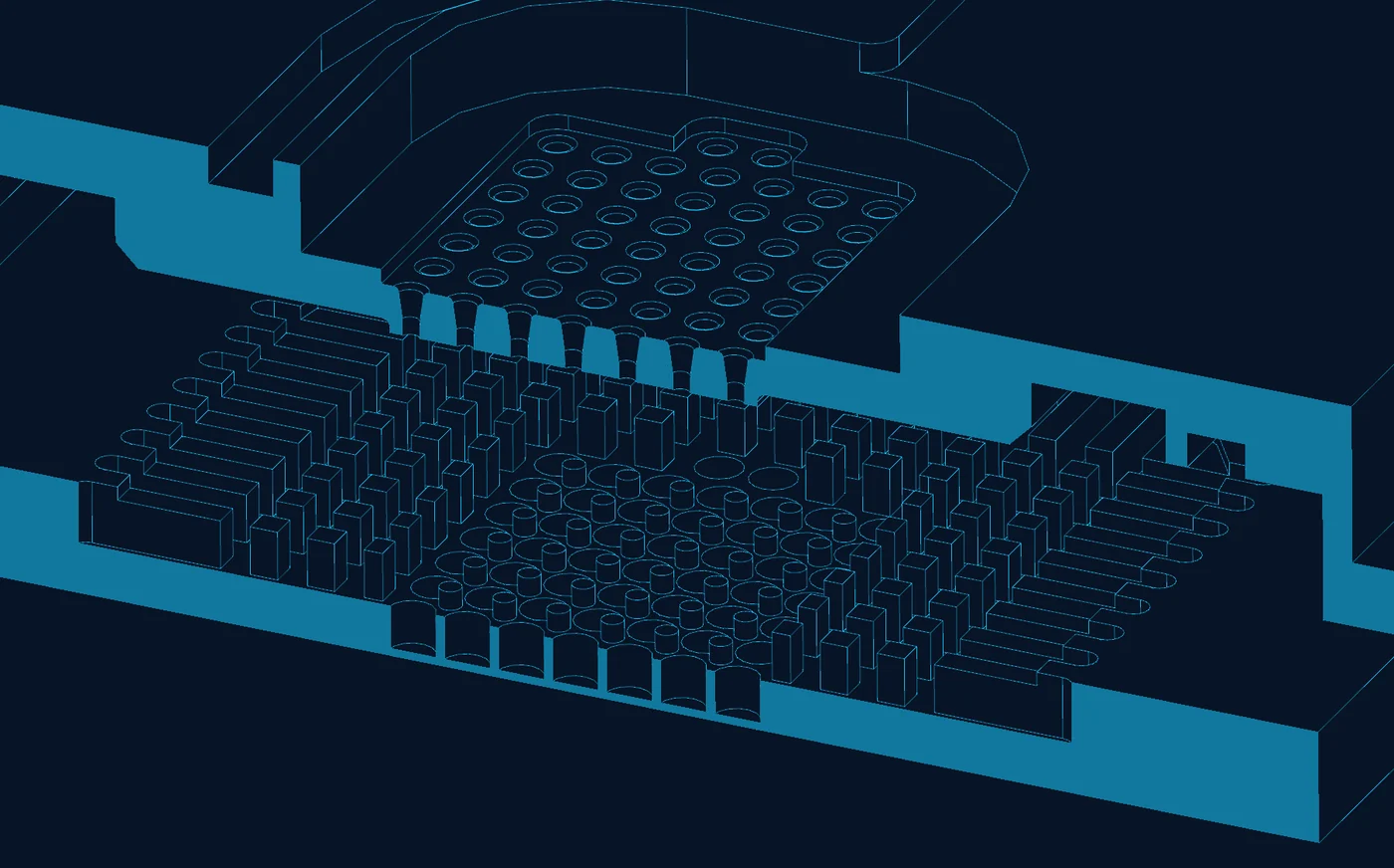
Most cold plates are a bath. Ours is a shower: dozens of fresh jets strike right above the hottest silicon. In a bath, coolant warms as it slides across the chip. Against the best conventional plates, jets run 2–3 °C cooler, at far less pumping pressure on server CPUs.
- Fresh coolant on every hot spot. Nozzles cluster over the hottest cores; no jet inherits another's heat.
- Low pressure. Small pumps, gentle on seals.
- Hot water allowed. Because jets cool so well, the water can arrive at 45 °C and leave at 60 °C: no chillers, and the heat is reusable. Design
- ≈16°C
- chip above its coolant: a 445 W GPU at 4.8 L/min Measured
- 1.1W
- pump power holds that GPU at 45 °C (electrical, on 20 °C water at 1 L/min) Measured
- ~25×
- less pumping pressure than a leading micro-channel plate, at similar cooling, on a 48-core server CPU test Measured
Less capex
Less opex
Longer life
Jet counts: 45 jets of 0.7 mm on a server CPU plate, 80 on a full-cover GPU block (2022 design specifications). ≈16 °C and 1.1 W are two different operating points of one test: single-slot GPU plate on an RTX 4090, FurMark at 445 W, 20 °C water; GPU core 36 °C at 4.8 L/min, and 44.9 °C at 1 L/min with the pump drawing 1.1 W (12 V × 0.088 A, electrical; 21.6 W at 4.8 L/min) (Nexalus single-slot white paper; SS GPU performance vs flow workbook, Jul 2026). ~25×: AMD EPYC 9474F (48 cores). The test record says a leading micro-channel plate needed about 8 psi (≈55 kPa) for a given cooling and the Nexalus jet array matched it at under 0.4 psi (under 3 kPa), "a nearly 25-fold reduction"; core rise ≈22–28 K vs ≈22–24 K across the flow range (Nexalus Snapshot comparison, May 2025; competitor shared with permission, named neutrally here). One CPU and one competitor plate. 2–3 °C cooler: head-to-heads at equal flow (full-cover GPU block: jets 36 vs 38 °C at ~4.5 L/min; 16-core desktop CPU: jets 68.2 vs 71.1 °C at 2 L/min, where the pressure drops were similar). 45 → 60 °C is a Nova 8 design value, not yet run (see T-2).
Chip temperature50 °C
Coolant out 33 °C37 °C below throttlePump ≈4 W
Chip temperature · same 445 W GPU
Pumping pressure at similar cooling
Micro-channel~55 kPa
Nexalus jets< 3 kPa
~25× less on a 48-core server CPU test Measured
Same 445 W GPU in every case. Jet temperatures follow a fit through two measured points; conventional and air are estimates. Jets measured Others estimated
Model: chip temperature = inlet + 8.5 + 16.4/√(flow) K for the jets (fit through measured 36.0 °C at 4.8 L/min and 44.9 °C at 1 L/min, 20 °C water, 445 W). Chip temperature is the GPU core temperature the card reports; its hot-spot sensor reads about 6 K higher (42.3 °C at 4.8 L/min). Conventional plate = jets + 2–3 K, from measured head-to-heads (full-cover block: jets 36 vs 38 °C at ~4.5 L/min; 16-core desktop CPU: jets 68.2 vs 71.1 °C for a micro-channel plate at 2 L/min). Pumping pressure: about 25× lower than a leading server micro-channel plate (≈55 vs under 3 kPa for similar cooling, measured on a 48-core EPYC); on the 16-core desktop test the micro-channel plate needed similar, slightly lower pressure (≈16.5 vs ≈22 kPa at 6 L/min). Air = inlet + ~49 K (estimate, ≈0.11 K/W; air-cooled GPUs typically run near ~90 °C, estimate). Coolant rise = 445 W / (flow × 4.19 kJ/kg·K). Pump power (electrical) = 1.1 W × flow1.9 (fit through measured 1.1 W at 1 L/min and 21.6 W at 4.8 L/min). Throttle ≈ 87 °C is a model assumption. Die profile and animation are illustrative.
T-1 · Jet impingement